Why it matters
It defines the starting state before the next response begins.
GlucoMove is built around one consistent reading order: Pre-meal → Medication → Meal → Activity → Post-meal. In daily use, the minimum useful dataset is pre-meal glucose, activity, and post-meal glucose. Meal and medication sharpen interpretation when available.
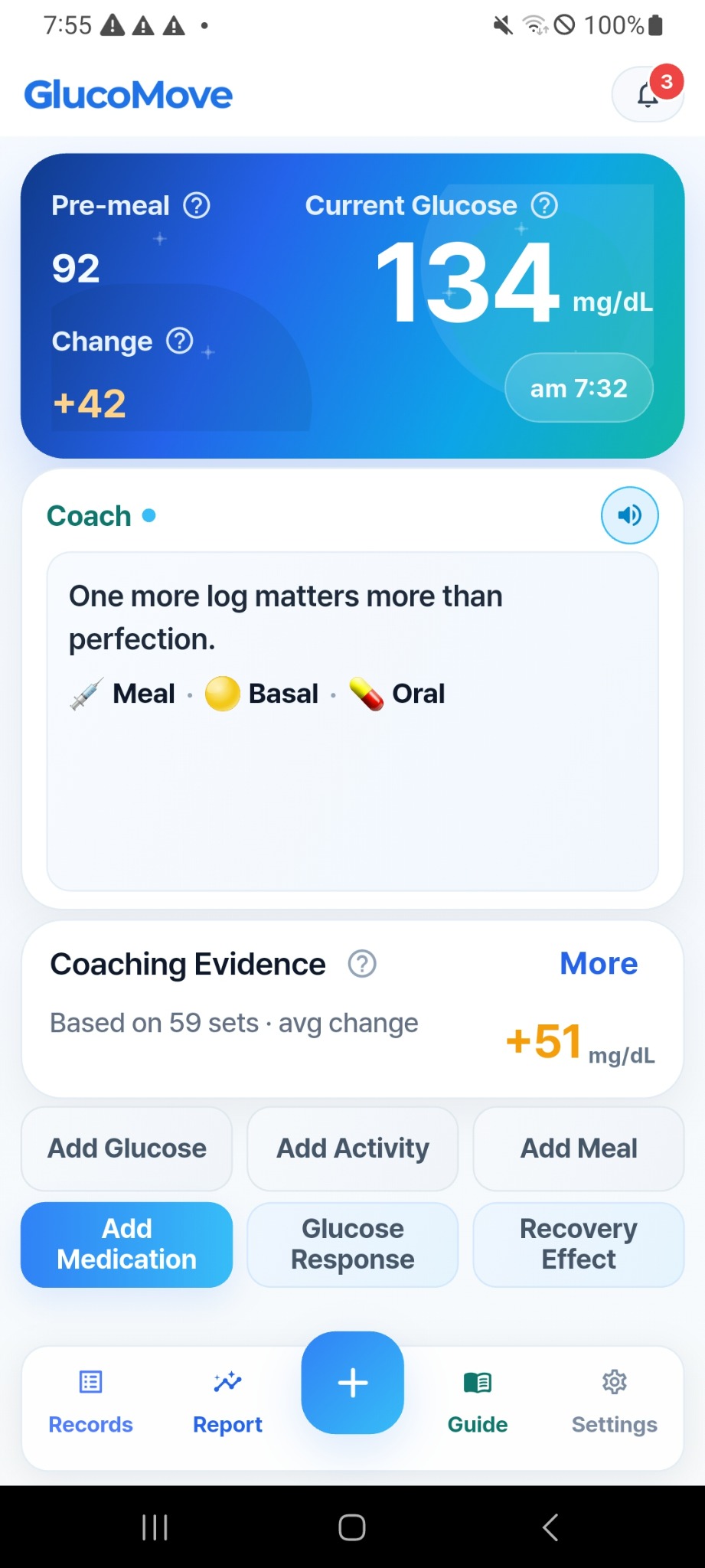
Communication across the whole site should always use the same full order. But for a daily dataset to become useful, the required points are pre-meal glucose, activity, and post-meal glucose. Meal and medication are valuable context, not mandatory every time.
Use the same order everywhere in UI, content, and guidance.
Pre-meal · Activity · Post-meal are the daily essentials.
Meal level and medication settings improve interpretation.
Pre-meal glucose shows where the event begins. It is the anchor point that gives later change its meaning.
It defines the starting state before the next response begins.
Meaningful comparison against the later post-meal value.
The later number becomes harder to interpret as change.
Medication appears in coaching when users enable medication reminders in settings. The app supports oral medication, GLP-1, and insulin, with insulin structured into basal, mealtime, and premixed types, simplified through common combination patterns.
Medication is not always shown. It becomes visible in coaching when the user has medication reminders configured.
Instead of forcing complex drug entry every time, GlucoMove uses a configured pattern that can trigger relevant reminders at the right time.
GlucoMove does not try to make users enter exact nutrients or precise portion weights every day. Meals are simplified into five carbohydrate levels so people can choose quickly and stay consistent. Users can also attach meal photos that appear later as thumbnails in Records.
Carbohydrate-based levels make meal entry fast, light, and repeatable.
Precise food input is hard to sustain and hard to measure accurately in real life.
Meal photos can be reviewed later in Records alongside the log itself.
Users can choose from more than 30 activity types, with seven recommended activities highlighted for real-life glucose spike control. Intensity is shown with three colored dot levels, and activity can be logged by 5-minute duration blocks or repetition counts. Photos can also be attached.
Structured enough to capture real-life differences between activities.
Designed around activities that are practical and effective for daily spike control.
Visualized with dots and color so intensity is easy to read quickly.
Users can log movement in the way that best matches the activity itself.
Ordinary datasets should talk about the change and whether the rise looked smaller. They should not claim an exact mg/dL reduction from activity because meal composition and quantity are not captured with laboratory precision in everyday use.
Look for whether the post-meal rise was smaller, more stable, or more predictable.
Ordinary daily datasets are strong for pattern reading, not for exact effect claims.
On difficult meal days, people may still be able to act through movement. That is why GlucoMove centers activity as a practical lever for making the rise feel smaller and the pattern more repeatable.
It can be repeated in ordinary life.
Users can feel and see that the post-meal change looked smaller.
Repeated sets make the routine easier to trust and reuse.